Beyond AI: 4 Emerging Technologies Disrupting US Industries by 2028 (INSIDER KNOWLEDGE)
While Artificial Intelligence (AI) continues to dominate headlines and boardrooms, a deeper dive into the technological landscape reveals a vibrant ecosystem of other emerging tech disruption poised to fundamentally reshape U.S. industries by 2028. The focus on AI, while warranted, often overshadows other groundbreaking advancements that promise to deliver equally, if not more, transformative impacts across various sectors. This article goes beyond the obvious, offering insider knowledge on four critical emerging technologies that every business leader, investor, and policymaker should be tracking.
The next five years will be characterized by unprecedented technological acceleration. The convergence of these advanced fields will not just optimize existing processes but create entirely new industries, job markets, and societal structures. Understanding these forces of emerging tech disruption is not merely about staying competitive; it’s about ensuring survival and fostering sustainable growth in a rapidly evolving global economy. We’re talking about shifts that will redefine manufacturing, healthcare, energy, logistics, and even the very fabric of our daily lives.
1. Quantum Computing: Unlocking Unprecedented Computational Power
Quantum computing, once the stuff of science fiction, is rapidly moving from theoretical possibility to practical application. Unlike classical computers that store information as bits (0s or 1s), quantum computers leverage quantum-mechanical phenomena like superposition and entanglement to process information in qubits. This allows them to perform complex calculations exponentially faster than even the most powerful supercomputers, opening doors to solving problems previously deemed intractable. The potential for emerging tech disruption here is immense.
1.1. Impact on Cryptography and Cybersecurity
One of the most immediate and profound impacts of quantum computing will be on cryptography. Current encryption standards, which form the backbone of secure communication and financial transactions, are vulnerable to quantum attacks. As quantum computers mature, they will be capable of breaking these codes with relative ease. This necessitates a rapid transition to quantum-resistant (post-quantum) cryptography. Governments and financial institutions are already investing heavily in this area, recognizing the existential threat posed by quantum computing to national security and economic stability.
1.2. Revolutionizing Drug Discovery and Materials Science
In healthcare, quantum computing promises to accelerate drug discovery and development by simulating molecular interactions with unparalleled accuracy. This could lead to the creation of novel drugs, personalized medicine, and more effective treatments for diseases that currently lack cures. Similarly, in materials science, quantum simulations can help engineers design new materials with specific properties, such as superconductors, more efficient catalysts, or lighter, stronger alloys, driving significant emerging tech disruption in manufacturing and aerospace.
1.3. Optimizing Logistics and Financial Modeling
Quantum algorithms are uniquely suited for optimization problems. This has massive implications for logistics, supply chain management, and financial modeling. Airlines could optimize flight paths and crew scheduling, logistics companies could find the most efficient delivery routes, and financial institutions could perform complex risk analysis and portfolio optimization with unprecedented speed and precision. The ability to model and optimize highly complex systems will give early adopters a significant competitive edge.

2. Synthetic Biology: Redesigning Life for Industrial Applications
Synthetic biology involves designing and constructing new biological parts, devices, and systems, or redesigning existing natural biological systems for useful purposes. It’s essentially engineering at the cellular and genetic level, offering a powerful toolkit for emerging tech disruption across diverse sectors. Think of it as programming biology, much like we program computers.
2.1. Sustainable Manufacturing and Biofuels
One of the most promising applications is in sustainable manufacturing. Synthetic biology can engineer microorganisms to produce a wide array of chemicals, materials, and fuels from renewable resources, reducing reliance on fossil fuels and petrochemicals. This includes bioplastics, biodegradable materials, and advanced biofuels that could transform the energy sector and significantly reduce industrial waste. Companies are already exploring engineered yeast and bacteria to produce everything from vanilla flavor to spider silk proteins.
2.2. Advanced Agriculture and Food Production
In agriculture, synthetic biology offers solutions to enhance crop yields, improve nutritional value, and develop disease-resistant plants. Imagine crops that can fix their own nitrogen, reducing the need for synthetic fertilizers, or plants engineered to thrive in harsh climates. Furthermore, cellular agriculture, which involves growing meat and dairy products from cells rather than animals, promises to revolutionize food production, addressing concerns about sustainability, ethics, and food security. This represents a monumental emerging tech disruption in how we feed the world.
2.3. Medical Breakthroughs and Therapeutics
The medical applications of synthetic biology are vast and potentially life-changing. This includes engineering bacteria to detect and treat diseases, developing novel gene therapies to correct genetic defects, and creating ‘smart’ cells that can deliver drugs precisely to cancerous tumors. The ability to program biological systems offers unprecedented control over disease mechanisms, paving the way for personalized and highly effective treatments.
3. Advanced Robotics and Autonomous Systems: The Next Generation of Automation
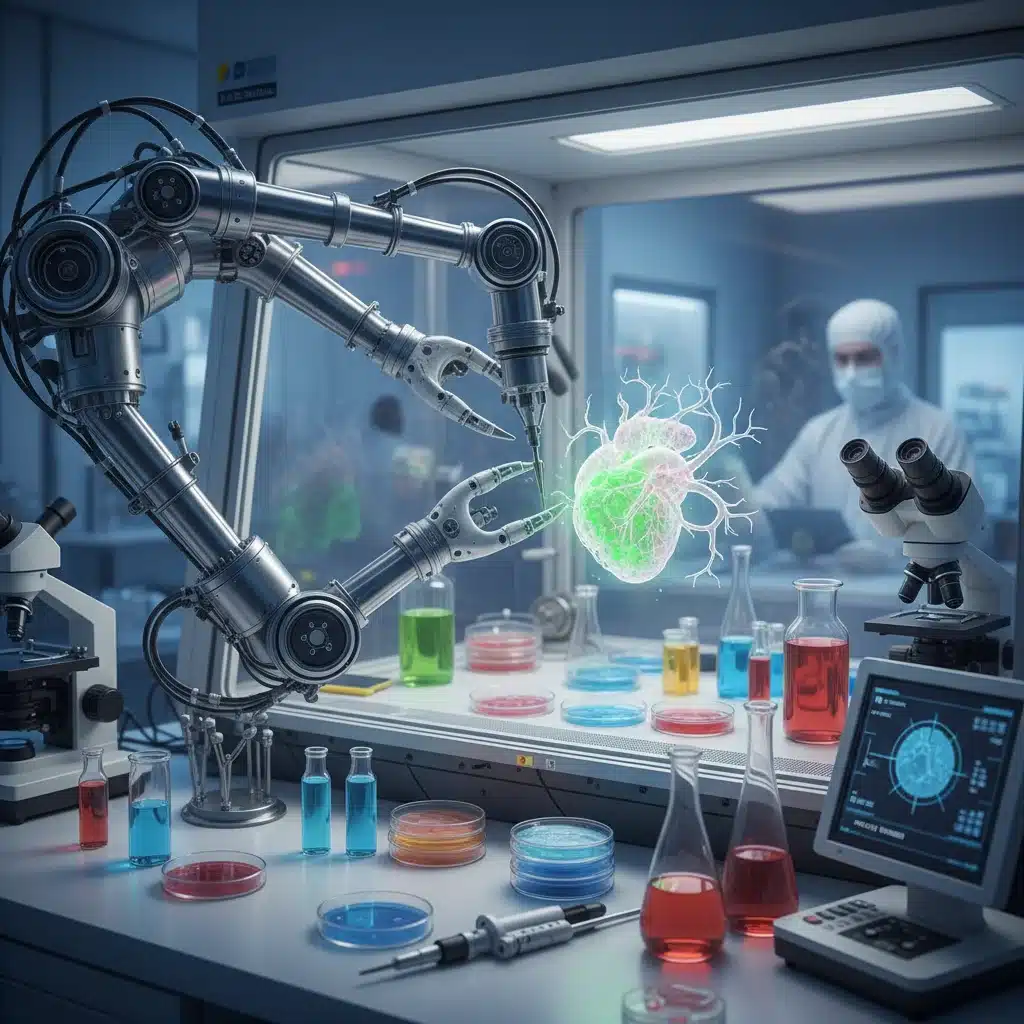
While industrial robots have been a staple in manufacturing for decades, the next wave of advanced robotics and autonomous systems represents a significant leap forward. These systems are characterized by enhanced AI integration, improved dexterity, advanced sensor fusion, and the ability to operate autonomously in complex, unstructured environments. This is a key area of emerging tech disruption that will redefine labor and productivity.
3.1. Collaborative Robots (Cobots) and Human-Robot Interaction
Cobots are designed to work alongside humans, augmenting their capabilities rather than replacing them entirely. These robots are equipped with advanced safety features and intuitive interfaces, making them accessible to a wider range of industries, including small and medium-sized enterprises (SMEs). Cobots can handle repetitive, strenuous, or dangerous tasks, freeing up human workers for more complex, creative, and value-added activities. This shift will improve workplace safety, efficiency, and overall productivity.
3.2. Autonomous Mobile Robots (AMRs) and Logistics
AMRs are revolutionizing logistics and warehousing. Unlike traditional automated guided vehicles (AGVs) that follow fixed paths, AMRs use onboard sensors and intelligence to navigate dynamic environments, avoid obstacles, and optimize routes in real-time. This flexibility allows them to integrate seamlessly into existing operations, enhancing efficiency in e-commerce fulfillment centers, manufacturing plants, and even hospitals. The widespread adoption of AMRs will lead to faster delivery times, reduced operational costs, and a more resilient supply chain.
3.3. Robotics in Service Industries and Beyond
Beyond manufacturing and logistics, advanced robotics are making inroads into service industries. Robots are being developed for elder care, hospitality (e.g., automated concierges, cleaning robots), and even retail (e.g., inventory management robots). Surgical robots are becoming more precise, and drone technology is expanding into infrastructure inspection, agriculture, and urban delivery. The pervasive nature of this emerging tech disruption will touch nearly every aspect of our economy.
4. Advanced Sustainable Energy Solutions: Powering the Future Responsibly
The global imperative to combat climate change and achieve energy independence is driving rapid innovation in sustainable energy. While solar and wind power are well-established, a new generation of advanced sustainable energy solutions is on the horizon, promising even greater efficiency, reliability, and scalability. This sector is a critical area of emerging tech disruption that will underpin all other technological advancements.
4.1. Next-Generation Battery Technologies
The limitations of current lithium-ion batteries—in terms of energy density, cost, and charging time—are being addressed by a flurry of research into next-generation alternatives. Solid-state batteries, which use solid electrodes and electrolytes, promise higher energy density, faster charging, and improved safety, potentially revolutionizing electric vehicles and grid-scale energy storage. Other promising technologies include sodium-ion, flow, and structural batteries, each with unique advantages for different applications. These advancements are crucial for the widespread adoption of renewable energy and electric transportation.
4.2. Advanced Nuclear Technologies (Small Modular Reactors – SMRs)
Nuclear power is experiencing a renaissance with the development of Small Modular Reactors (SMRs). These advanced reactors are smaller, simpler, and can be mass-produced, significantly reducing construction costs and timelines compared to traditional large-scale nuclear plants. SMRs offer a reliable, carbon-free baseload power source that can be deployed in diverse locations, including remote communities and industrial sites. Their inherent safety features and ability to integrate with renewable energy sources make them a compelling solution for a sustainable energy future, driving significant emerging tech disruption in the power sector.
4.3. Green Hydrogen Production and Applications
Green hydrogen, produced by electrolyzing water using renewable electricity, is emerging as a critical energy carrier and industrial feedstock. It can be used to decarbonize heavy industries (steel, chemicals), power fuel cell electric vehicles (FCEVs), and store excess renewable energy. Advances in electrolyzer efficiency and cost reduction are making green hydrogen increasingly viable, creating a new energy economy that could fundamentally shift global energy dynamics. The infrastructure required for green hydrogen production, storage, and distribution will be a massive area of investment and innovation.
The Interconnected Future: Convergence and Synergies
It’s crucial to understand that these four emerging tech disruption areas do not exist in isolation. Their true transformative power lies in their convergence and the synergies they create. For instance:
- Quantum computing could accelerate the design of new materials for advanced batteries and more efficient catalysts for green hydrogen production.
- Synthetic biology could engineer microorganisms to produce biofuels or capture carbon more efficiently, powered by advanced sustainable energy solutions.
- Advanced robotics could be deployed to build and maintain SMRs, manage complex green hydrogen facilities, or automate the production of synthetic biological products.
- The data generated by vast networks of autonomous systems will require quantum-safe encryption and quantum-inspired optimization algorithms for efficient processing and security.
This interconnectedness means that investment and progress in one area often accelerate breakthroughs in others, creating a powerful virtuous cycle of innovation. Businesses that recognize and capitalize on these convergences will be best positioned to thrive in the coming decade.
Navigating the Disruption: Strategies for U.S. Industries
For U.S. industries to not only survive but lead in this era of emerging tech disruption, several strategic imperatives are clear:
- Investment in R&D: Continuous and significant investment in research and development, both private and public, is paramount. This includes funding basic science and applied research in these critical areas.
- Talent Development: A skilled workforce is the bedrock of innovation. Educational institutions and industries must collaborate to train the next generation of quantum engineers, synthetic biologists, roboticists, and energy scientists. Reskilling and upskilling existing workforces will also be vital.
- Policy and Regulation: Governments must create agile regulatory frameworks that foster innovation while addressing ethical concerns and ensuring public safety. This includes intellectual property protection, data privacy, and ethical guidelines for AI and synthetic biology.
- Cross-Sector Collaboration: Breaking down silos between industries and fostering collaboration between academia, startups, and established corporations will accelerate the adoption and integration of these technologies.
- Risk Management: Understanding the potential risks associated with these technologies—from cybersecurity threats posed by quantum computing to the ethical implications of synthetic biology—is crucial for responsible development and deployment.
The U.S. has a unique opportunity to solidify its position as a global leader in innovation by strategically investing in and nurturing these emerging tech disruption areas. Failure to do so risks falling behind nations that are aggressively pursuing these frontiers.
Conclusion: The Future is Now
The period between now and 2028 promises to be one of the most dynamic and transformative in recent history. While AI rightly commands attention, the true landscape of emerging tech disruption is far richer and more complex. Quantum computing, synthetic biology, advanced robotics, and next-generation sustainable energy solutions are not distant dreams but increasingly tangible realities that will redefine industries, economies, and societies. For businesses and nations alike, the time to understand, invest in, and adapt to these powerful forces is not tomorrow, but today. The future is not just coming; it’s already here, demanding our attention and proactive engagement.