Digital Declutter for Focus: Reclaim 10+ Hours Weekly in 2026

Implementing the 3-Step Digital Declutter for Enhanced Focus in 2026: A Practical Guide to Reclaiming 10+ Hours Weekly
In our hyper-connected world, the constant barrage of notifications, endless scrolling, and the pervasive presence of digital devices have become an inescapable part of daily life. While technology offers undeniable benefits, it often comes at the cost of our focus, productivity, and overall well-being. As we step into 2026, the need for a strategic approach to managing our digital lives has never been more critical. This comprehensive guide introduces a powerful 3-step digital declutter process designed to help you reclaim your attention, boost your productivity, and ultimately, free up an astonishing 10+ hours of your week.
The concept of a digital declutter focus isn’t just about reducing screen time; it’s about intentionality. It’s about consciously choosing how and when technology serves you, rather than allowing it to dictate your every moment. Imagine a life where you’re less distracted, more present, and have ample time for meaningful activities, creative pursuits, or simply quiet reflection. This isn’t a pipe dream; it’s an achievable reality through a systematic digital declutter. We’ll delve deep into actionable strategies, psychological insights, and practical tips to implement this transformative process effectively.
The Pervasive Problem: Why We Need a Digital Declutter Focus Now More Than Ever
Before we dive into the solution, it’s crucial to understand the depth of the problem. Our digital habits have evolved, often unconsciously, into patterns that diminish our capacity for deep work, sustained attention, and genuine connection. Consider these alarming statistics and observations:
- Decreased Attention Spans: Studies show a significant decline in average human attention spans, often attributed to the rapid-fire, notification-driven nature of digital interactions.
- Constant Distraction: Every ping, buzz, and email notification pulls us away from the task at hand, leading to ‘attention residue’ where our minds linger on the previous distraction, impacting subsequent tasks.
- Information Overload: The sheer volume of information available online can be overwhelming, leading to decision fatigue and a sense of being perpetually behind.
- Erosion of Deep Work: Cal Newport, author of ‘Deep Work,’ argues that our inability to focus without distraction on a cognitively demanding task is being severely compromised by our digital habits.
- FOMO and Social Comparison: The curated realities presented on social media often fuel anxiety, inadequacy, and a fear of missing out, further eroding mental peace.
- Sleep Disruption: Blue light exposure from screens, especially before bedtime, interferes with melatonin production, leading to poor sleep quality.
- Lost Time: The cumulative minutes spent mindlessly scrolling or checking devices add up to hours, even days, each week – time that could be invested in more fulfilling activities.
Recognizing these challenges is the first step towards embracing a digital declutter focus. It’s not about demonizing technology, but about mastering its use to serve our goals, rather than letting it master us. The year 2026 presents an ideal opportunity to reset and cultivate healthier digital habits that will pay dividends in every area of your life.
Step 1: Audit Your Digital Landscape – The Foundation of Your Digital Declutter Focus
The initial phase of any effective digital declutter is a thorough audit of your current digital consumption. You can’t fix what you don’t understand. This step requires honesty and a willingness to confront your habits, even the uncomfortable ones.
Phase 1.1: Track Your Screen Time – Unmasking the Time Thieves
Most smartphones and operating systems now come with built-in screen time trackers. If yours doesn’t, there are numerous third-party apps available (e.g., RescueTime, Moment, StayFree). For one week, commit to tracking every minute you spend on your devices. Pay attention to:
- Total Screen Time: How many hours per day/week are you staring at a screen?
- App-Specific Usage: Which apps consume the most of your time? Is it social media, news, entertainment, or productivity tools?
- Pickups and Notifications: How many times do you pick up your phone, and how many notifications do you receive? Each pickup is a potential distraction.
- Time of Day: When are your peak usage times? Is it first thing in the morning, late at night, or during work hours?
The goal here is awareness, not judgment. You might be surprised by the actual figures. This data will be invaluable in identifying your biggest digital time sinks and informing your digital declutter focus strategy.
Phase 1.2: Identify Your Digital Triggers and Cravings
Beyond raw numbers, understand the ‘why’ behind your digital habits. What triggers you to reach for your phone or open a specific app?
- Boredom: Do you instinctively grab your phone when waiting in line or during a lull in conversation?
- Stress/Anxiety: Do you turn to social media or endless scrolling as a coping mechanism?
- Procrastination: Is checking email or news a way to avoid more challenging tasks?
- Social Connection: Do you feel compelled to constantly check for messages or updates from friends/family?
- Fear of Missing Out (FOMO): The urge to stay constantly updated on news, trends, or social events.
Journaling about these moments can be incredibly insightful. When you find yourself reaching for a device, pause and ask: “What am I feeling right now?” or “What do I hope to gain from this interaction?” Understanding these triggers is paramount to building sustainable new habits for a stronger digital declutter focus.
Phase 1.3: Evaluate Your Digital Toolkit – Necessity vs. Novelty
Go through every app on your phone, every subscription service, every email newsletter, and every social media account. Ask yourself:
- Does this serve a clear purpose in my life?
- Does it genuinely add value, or is it a distraction?
- When was the last time I actively used this?
- Could I achieve the same outcome with less digital interaction?
Be ruthless in this evaluation. Many apps are designed to be addictive, not necessarily productive or enriching. This critical assessment forms the bedrock for the next, more active phase of your digital declutter focus journey.
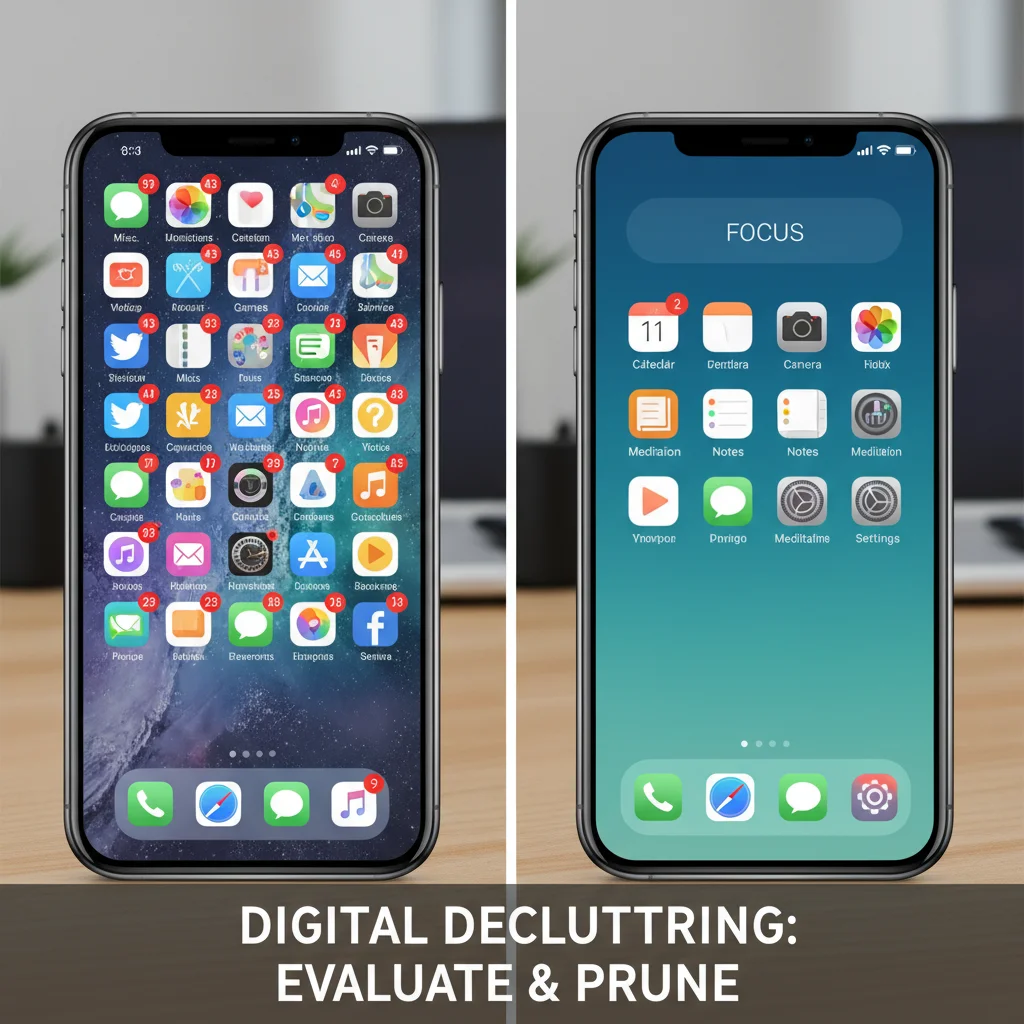
Step 2: Evaluate and Prune – Cultivating a Minimalist Digital Environment
Once you have a clear picture of your digital habits and tools, it’s time to take action. This step is about actively removing distractions and optimizing your digital environment to support your renewed focus.
Phase 2.1: Declutter Your Devices – Apps, Notifications, and Home Screens
This is where the magic happens. Based on your audit, begin to prune:
- Delete Unnecessary Apps: If an app doesn’t serve a clear purpose or hasn’t been used in months, delete it. If you’re unsure, move it to a separate folder or off your main home screen.
- Turn Off Non-Essential Notifications: This is perhaps the single most impactful step. Go into your phone settings and disable notifications for *all* non-essential apps. This includes social media, news alerts, games, and even some communication apps outside of immediate family/work. Consider batching communication (e.g., checking messages only at specific times).
- Simplify Your Home Screen: Your phone’s home screen should be a launchpad for productivity, not a billboard for distractions. Remove all social media apps from your main home screen. Consider a minimalist setup with only essential tools (phone, camera, calendar, maps) and perhaps a single folder for ‘utilities.’
- Grayscale Mode: Experiment with turning your phone screen to grayscale. The lack of vibrant colors can significantly reduce the addictive pull of your device.
- Set App Limits: Use your phone’s built-in features (e.g., ‘App Limits’ on iOS, ‘Digital Wellbeing’ on Android) to set daily time limits for specific apps or categories of apps (e.g., 30 minutes for social media).
The goal is to make your devices less appealing and less demanding of your attention. A streamlined digital environment is a cornerstone of a strong digital declutter focus.
Phase 2.2: Email and Digital Communication Overhaul
Email can be a massive source of distraction. Take control:
- Unsubscribe Relentlessly: Go through your inbox and unsubscribe from every newsletter, promotional email, or marketing list that doesn’t genuinely add value. Use tools like Unroll.me if you have hundreds.
- Create Folders/Labels: Organize your remaining emails into categories (e.g., ‘Action Required,’ ‘Reading,’ ‘Archive’).
- Schedule Email Checking: Avoid checking email constantly. Designate specific times of the day (e.g., 9 AM, 1 PM, 4 PM) for processing emails. Close your email client outside of these windows.
- Automate Responses: For non-urgent matters, consider using automated responses to manage expectations about your response time.
Applied to your communication, this phase significantly bolsters your digital declutter focus, allowing for uninterrupted blocks of time.
Phase 2.3: Optimize Your Computer and Browser Environment
Your computer is often a larger source of distraction than your phone. Apply similar principles:
- Desktop Declutter: Clear your desktop of unnecessary files and shortcuts. Use a clean, inspiring background.
- Browser Tab Management: Limit the number of open tabs. Use extensions like OneTab or The Great Suspender to manage tab overload.
- Website Blockers: Install website blockers (e.g., Freedom, Cold Turkey) to block distracting sites during designated focus periods.
- Notification Control: Disable browser notifications and pop-ups that aren’t critical.
- Organize Files: Implement a consistent file organization system to reduce digital clutter and wasted time searching for documents.
A tidy digital workspace, both on your phone and computer, is essential for maintaining a clear digital declutter focus.
Step 3: Reclaim Your Time and Space – Living Intentionally with Your Digital Declutter Focus
The final step moves beyond mere removal to active cultivation of new, healthier habits and the intentional creation of space for what truly matters.
Phase 3.1: Establish Digital-Free Zones and Times
This is about creating boundaries that protect your focus and presence:
- Bedrooms as No-Phone Zones: Charge your phone outside your bedroom. Use an old-fashioned alarm clock. This dramatically improves sleep quality and prevents late-night scrolling.
- Mealtime as No-Phone Zones: Enjoy meals with family or friends without digital interruptions. Be present.
- First and Last Hour of the Day: Dedicate the first hour after waking and the last hour before bed to non-digital activities. Read a book, meditate, journal, or spend time with loved ones. This sets a positive tone for the day and winds you down effectively.
- Digital Sabbaths: Consider taking a full day each week (e.g., Sunday) completely free from non-essential digital devices.
- Designated Work/Study Blocks: Use the Pomodoro Technique or similar time management methods to create blocks of uninterrupted work, placing your phone in another room or on silent during these times.
These boundaries are crucial for embedding a sustainable digital declutter focus into your daily routine.
Phase 3.2: Cultivate Analog Alternatives and New Hobbies
The vacuum created by reducing digital consumption needs to be filled with enriching alternatives. This is where you reclaim your lost hours:
- Rediscover Reading: Pick up physical books, magazines, or newspapers.
- Engage in Hobbies: Dust off that guitar, start painting, try gardening, learn a new language, or go for a walk in nature.
- Connect In-Person: Spend quality time with friends and family without the distraction of screens.
- Learn and Create: Use your newfound time for creative projects, skill development, or deep learning that doesn’t involve endless scrolling.
- Practice Mindfulness: Meditation, journaling, or simply observing your surroundings can help you appreciate the present moment.
The more fulfilling analog activities you integrate, the less you’ll feel the pull of digital distractions. This is the ultimate expression of a successful digital declutter focus.

Phase 3.3: Reflect, Adapt, and Sustain Your Digital Declutter Focus
A digital declutter isn’t a one-time event; it’s an ongoing practice. Regularly reflect on your progress:
- Weekly Check-ins: Review your screen time. Did you meet your goals? Where did you struggle?
- Adjust as Needed: What worked well? What needs tweaking? Perhaps you need to block a specific website more aggressively, or you discovered a new analog activity you love.
- Be Kind to Yourself: There will be slip-ups. Don’t let a moment of weakness derail your entire effort. Acknowledge it, learn from it, and get back on track.
- Communicate Your Intentions: Let friends, family, and colleagues know about your digital boundaries. This can create a supportive environment and reduce the pressure to be constantly available.
- Focus on the Benefits: Regularly remind yourself of the positive changes you’re experiencing – improved focus, better sleep, more time, reduced anxiety. This positive reinforcement fuels your motivation.
Sustaining your digital declutter focus requires continuous effort, but the rewards are immeasurable. It’s about building a healthier, more intentional relationship with technology that empowers you, rather than enslaves you.
Measuring Your Success: Reclaiming 10+ Hours Weekly
So, how do you actually reclaim 10+ hours weekly with a strong digital declutter focus? Let’s break it down with some realistic examples:
- Reducing Mindless Scrolling (e.g., social media, news feeds): If you currently spend 2-3 hours a day on these activities, cutting that in half (1-1.5 hours) immediately saves 7-10.5 hours per week.
- Fewer Phone Pickups/Notifications: Each time you’re distracted, it takes approximately 23 minutes to regain full focus. Even reducing 10-15 significant distractions a day can save hours of lost productivity and mental energy. If each distraction costs you even 5 minutes to recover, 10 distractions mean 50 minutes lost daily, or nearly 6 hours weekly.
- Optimizing Email: Checking email every 15 minutes vs. 3 times a day. If each check takes 5 minutes, and you check 10 times vs. 3 times, you save 35 minutes daily, or over 4 hours weekly. Plus, the mental overhead saved is invaluable.
- Productivity Gains: With enhanced focus, tasks that once took an hour might now take 45 minutes. Over a work week, these small gains add up significantly.
- Improved Sleep: Better sleep leads to more energy and sharper cognitive function, making you more efficient during your waking hours. This is an indirect but powerful time-saver.
By diligently applying the 3-step digital declutter process, these gains are not only possible but probable. The reclaimed time isn’t just empty space; it’s an opportunity to invest in your passions, relationships, health, and personal growth.
The Long-Term Benefits of a Sustainable Digital Declutter Focus
Beyond the immediate gain of time, committing to a digital declutter focus offers a cascade of long-term benefits:
- Enhanced Mental Clarity: Less digital noise means a quieter mind, fostering clearer thinking and better decision-making.
- Increased Creativity: Boredom, often stifled by instant digital gratification, is a powerful catalyst for creative thought.
- Improved Relationships: Being truly present with loved ones strengthens bonds and creates deeper connections.
- Reduced Stress and Anxiety: Disconnecting from the constant demands of the digital world can significantly lower stress levels and reduce feelings of overwhelm.
- Better Sleep Quality: Limiting screen time before bed leads to more restorative sleep.
- Greater Self-Awareness: Without constant external stimulation, you’re more attuned to your inner thoughts, feelings, and needs.
- Boosted Productivity and Efficiency: Uninterrupted focus allows you to accomplish more in less time, leading to a greater sense of achievement.
- More Intentional Living: You become the master of your attention, directing it towards what genuinely matters to you.
Conclusion: Embrace Your Digital Declutter Focus in 2026
The year 2026 is an invitation to redefine your relationship with technology. The 3-step digital declutter framework – Audit, Evaluate & Prune, and Reclaim – provides a clear, actionable path to achieving enhanced focus and reclaiming over 10 hours weekly. This isn’t about abandoning technology but about using it judiciously and with purpose. By implementing these strategies, you’re not just decluttering your devices; you’re decluttering your mind, your schedule, and ultimately, your life. Start today, and experience the profound benefits of a truly intentional and focused digital existence.