AI Revolution: 6-Month Action Plan for U.S. Professionals

Navigating the AI Revolution: A 6-Month Action Plan for U.S. Professionals (TIME-SENSITIVE)
The AI revolution is not a distant future; it’s a present reality that is rapidly reshaping industries, job markets, and daily professional life across the United States. For U.S. professionals, this isn’t just another technological trend; it’s a fundamental shift demanding immediate attention and strategic adaptation. The window for proactive engagement is narrowing, and those who fail to prepare risk being left behind. This comprehensive AI Revolution Action Plan is designed to provide you with a clear, actionable roadmap for the next six months, ensuring you not only survive but thrive in this transformative era.
The urgency cannot be overstated. From automating routine tasks to generating creative content and analyzing complex data, artificial intelligence is permeating every facet of the professional landscape. Understanding its implications, identifying opportunities, and acquiring relevant skills are no longer optional – they are imperative. This guide breaks down the daunting task of AI integration into manageable, monthly steps, focusing on practical skills, strategic thinking, and continuous learning. By the end of this 6-month journey, you will be equipped with the knowledge and capabilities to confidently navigate the AI-driven world, making yourself indispensable in your chosen field. Let’s embark on this critical journey together to master the AI Revolution Action Plan.
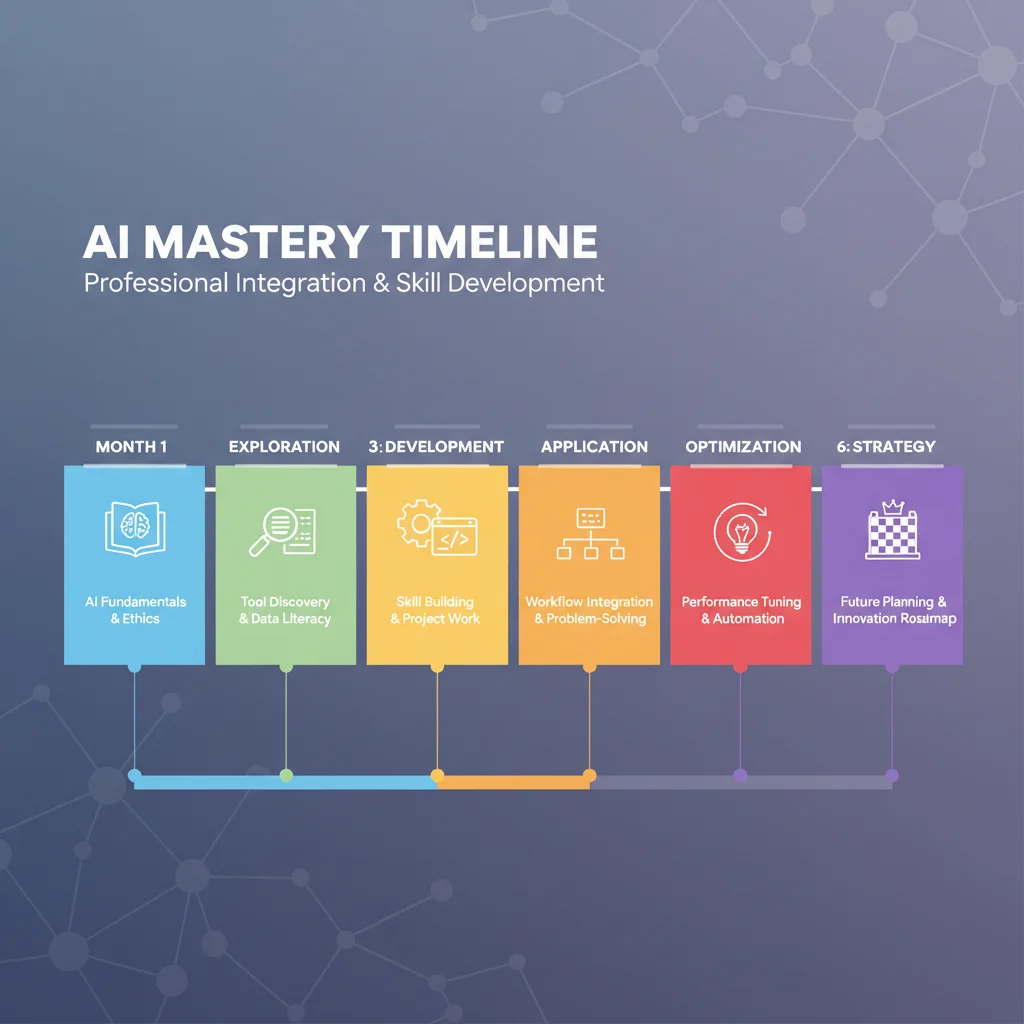
Month 1: Understanding the AI Landscape and Its Impact
The first month of your AI Revolution Action Plan is dedicated to building a foundational understanding of what AI truly is, its current capabilities, and its potential impact on your specific industry and role. This isn’t about becoming an AI engineer, but rather a well-informed professional who can speak intelligently about AI and recognize its relevance.
Week 1: Demystifying AI Fundamentals
- What is AI? Start with the basics. Explore different types of AI (machine learning, deep learning, natural language processing, computer vision) and their core principles. Utilize online courses from platforms like Coursera, edX, or Google AI. Focus on conceptual understanding rather than technical implementation.
- Key Terms and Concepts: Familiarize yourself with terms like algorithms, neural networks, data sets, predictive analytics, generative AI, and automation. A solid vocabulary will enable you to engage in meaningful discussions.
- AI in Your Daily Life: Identify how AI is already impacting your personal and professional life. Think about recommendation engines, spam filters, virtual assistants, and automated customer service. This helps to normalize the technology and reduce any intimidation.
Week 2: Industry-Specific AI Trends
- Research Your Sector: How is AI being applied in your industry? Look for case studies, white papers, and industry reports. Are competitors using AI? In what areas (e.g., finance, healthcare, marketing, manufacturing)?
- Identify Emerging Technologies: Stay updated on the latest AI tools and platforms relevant to your field. For instance, if you’re in marketing, explore AI-driven content generation tools; if in finance, look into AI for fraud detection or trading algorithms.
- Future Projections: Read analyses from reputable sources (e.g., McKinsey, PwC, Deloitte) on AI’s projected impact on your industry over the next 5-10 years. This foresight is crucial for long-term career planning within your AI Revolution Action Plan.
Week 3: Impact on Job Roles and Skills
- Job Displacement vs. Job Transformation: Understand that AI is more likely to transform roles than completely eliminate them. Identify which tasks within your current role are most susceptible to automation and which require uniquely human skills (creativity, emotional intelligence, critical thinking).
- Skills Gap Analysis: Compare the skills currently in demand for AI-influenced roles in your industry with your existing skillset. This initial gap analysis will inform your learning path for the coming months.
- Emerging Roles: Research new job titles and functions emerging due to AI (e.g., AI Ethicist, Prompt Engineer, Data Storyteller). Consider how your skills might pivot towards these opportunities.
Week 4: Ethical Considerations and Responsible AI
- Bias in AI: Learn about how biases can be embedded in AI systems and their societal implications. Understanding these challenges is vital for responsible AI development and deployment.
- Privacy and Data Security: Explore the intersection of AI, data privacy regulations (like GDPR, CCPA), and cybersecurity. This is a growing area of concern and expertise.
- Ethical Frameworks: Familiarize yourself with discussions around ethical AI guidelines and principles. Being able to contribute to these conversations adds significant value. This foundational month sets a robust stage for your ongoing AI Revolution Action Plan.
Month 2: Core AI Literacy and Tool Exploration
Having grasped the foundational concepts, Month 2 shifts your AI Revolution Action Plan towards practical AI literacy. This involves getting hands-on with AI tools and understanding how they function at a user level, rather than a developer level. The goal is to become proficient in using AI as a productivity enhancer and a strategic asset.
Week 5: Exploring Generative AI Tools
- Text Generation: Experiment with large language models (LLMs) like ChatGPT, Google Bard, or Claude. Practice crafting effective prompts for various tasks: drafting emails, summarizing documents, brainstorming ideas, or even writing basic code snippets. Understand their limitations and best use cases.
- Image Generation: Dive into platforms like Midjourney, DALL-E, or Stable Diffusion. Learn the art of prompt engineering for visual creation. This skill is becoming increasingly valuable for marketing, design, and content creation.
- Code Assistants: If your role involves any coding or data analysis, explore tools like GitHub Copilot or similar AI code assistants. Understand how they can accelerate development and improve code quality.
Week 6: Data Analysis and AI Insights
- AI-Powered Data Tools: Investigate how AI is integrated into popular data analysis platforms (e.g., Excel with Copilot, Google Sheets with AI features, Tableau, Power BI). Learn to leverage AI for data cleaning, pattern recognition, and generating insights.
- Basic Data Interpretation: Understand how to interpret the outputs of AI models, even if you’re not building them. This includes recognizing correlations, understanding probabilities, and identifying potential biases in data-driven conclusions.
- Predictive Analytics Basics: Get a conceptual understanding of how AI can be used for forecasting and prediction in your business context. Think about sales forecasting, customer churn prediction, or market trend analysis.
Week 7: Automation and Workflow Optimization
- Robotic Process Automation (RPA): Explore RPA tools and concepts. Identify repetitive, rule-based tasks in your workflow that could potentially be automated using AI-driven RPA solutions.
- AI in Productivity Suites: Maximize your use of AI features embedded in common productivity software (Microsoft 365 Copilot, Google Workspace AI integration). Learn how AI can help draft documents, create presentations, and manage calendars more efficiently.
- Workflow Mapping: Document your current workflows and identify bottlenecks where AI could provide significant efficiency gains. This practical application of your learning is a core part of your AI Revolution Action Plan.
Week 8: Critical Evaluation and Responsible Use
- Fact-Checking AI Outputs: Develop a critical eye for AI-generated content. Understand the importance of verifying information and checking for accuracy, bias, or hallucinations.
- Data Privacy Best Practices: Revisit data privacy in the context of using AI tools. Understand what data you can and cannot input into public AI models, especially sensitive or proprietary information.
- Ethical Tool Usage: Reflect on the ethical implications of using AI in your work. When is it appropriate to use AI? How do you ensure transparency and fairness? This continuous self-assessment is crucial.
Month 3: Skill Refinement and Strategic Application
With a solid grasp of AI fundamentals and practical tool experience, Month 3 of your AI Revolution Action Plan focuses on refining your skills and strategically applying AI within your professional context. This is where theoretical knowledge begins to translate into tangible value.
Week 9: Advanced Prompt Engineering
- Contextual Prompts: Learn to provide detailed context, examples, and constraints to AI models for more precise and relevant outputs.
- Iterative Prompting: Master the art of refining prompts based on initial AI responses, iteratively guiding the AI towards the desired outcome.
- Chaining Prompts: Explore how to break down complex tasks into smaller, sequential prompts to achieve sophisticated results. This skill is becoming a highly sought-after capability.
Week 10: AI in Project Management and Collaboration
- AI for Planning: Investigate how AI tools can assist in project planning, resource allocation, and risk assessment.
- Automated Reporting: Learn to leverage AI to generate reports, summaries, and analyses from project data, freeing up time for strategic decision-making.
- AI in Communication: Use AI to streamline internal and external communications, from drafting meeting agendas to summarizing lengthy email threads.
Week 11: Creativity and Innovation with AI
- Brainstorming Partner: Use generative AI as a brainstorming partner to explore new ideas, concepts, and solutions for challenges in your role or industry.
- Content Creation Enhancement: Apply AI to enhance your creative output, whether it’s drafting marketing copy, generating design concepts, or outlining presentations. Remember, AI is a co-pilot, not a replacement for human creativity.
- Problem-Solving: Challenge yourself to use AI to analyze complex problems and suggest potential solutions, fostering innovative thinking. This is a critical component of your AI Revolution Action Plan.
Week 12: Measuring AI Impact and ROI
- Define Metrics: For the AI applications you’ve explored, consider how you would measure their effectiveness. What are the key performance indicators (KPIs)?
- Pilot Projects: If feasible, propose or participate in a small-scale pilot project within your team or department to test an AI tool or application. Document the process and results.
- Cost-Benefit Analysis: Begin to think about the return on investment (ROI) for AI implementation. How much time saved? How much efficiency gained? This strategic perspective will elevate your contributions.
Month 4: Specialization and Deeper Dive
By Month 4, your AI Revolution Action Plan moves into a phase of deeper specialization. You’ll identify specific areas where AI can provide the most value to your career and industry and commit to mastering those applications. This might involve diving into more technical aspects or focusing on specific AI domains.
Week 13: Advanced AI in Your Niche
- Deep Dive into Specific Tools: If you found a particular AI tool or platform highly relevant in Month 2 or 3, dedicate this week to becoming an expert user. Explore advanced features, integrations, and best practices.
- Industry-Specific AI Platforms: Research and learn about specialized AI platforms tailored to your industry (e.g., AI in legal tech, MedTech AI, FinTech AI solutions).
- AI for Competitive Advantage: Analyze how your organization or industry can leverage AI for competitive advantage. This could involve process optimization, new product development, or enhanced customer experience.
Week 14: Data Science & Machine Learning (Conceptual)
- Machine Learning Workflow: Gain a conceptual understanding of the machine learning pipeline: data collection, preprocessing, model training, evaluation, and deployment. You don’t need to code, but understand the stages.
- Key ML Algorithms: Learn about common machine learning algorithms like regression, classification, and clustering, and their business applications.
- Understanding Model Limitations: Grasp the concepts of overfitting, underfitting, and model bias. This will help you critically evaluate AI solutions and data-driven insights.
Week 15: AI Ethics and Governance (Advanced)
- AI Governance Frameworks: Explore more sophisticated AI governance models and regulatory landscapes emerging in the U.S. and globally.
- Explainable AI (XAI): Understand the importance of XAI – making AI decisions understandable to humans. This is crucial for trust and compliance, especially in regulated industries.
- Bias Detection and Mitigation: Learn about strategies and tools used to detect and mitigate bias in AI models. This knowledge positions you as a responsible AI advocate.
Week 16: Building Your AI Network
- Join Online Communities: Participate in AI-focused forums, LinkedIn groups, or Slack communities relevant to your industry or interests.
- Attend Webinars and Conferences: Seek out virtual or local AI events. Even attending free webinars can provide valuable insights and networking opportunities.
- Connect with Peers: Identify colleagues or industry peers who are also exploring AI. Share knowledge, discuss challenges, and collaborate on learning initiatives. This collaborative spirit is essential for a successful AI Revolution Action Plan.
Month 5: Leadership and Implementation
Month 5 shifts your focus from personal learning to organizational impact within your AI Revolution Action Plan. You’ll begin to strategically integrate AI into your team or department’s operations and position yourself as an AI champion.
Week 17: Identifying AI Opportunities in Your Organization
- Departmental Audit: Conduct an informal audit of your department’s processes. Where are the inefficiencies? What tasks are repetitive? Where could AI offer a competitive edge?
- Stakeholder Interviews: Speak with colleagues and managers about their pain points and areas where they believe technology could help. This helps identify practical AI applications.
- Propose AI Solutions: Based on your audit and interviews, formulate concrete proposals for how AI tools or strategies could address specific challenges or create new opportunities.
Week 18: Developing an AI Implementation Strategy
- Pilot Project Planning: If you identified a promising opportunity, start drafting a mini-project plan for an AI pilot. Define scope, objectives, success metrics, and required resources.
- Change Management Considerations: Think about the human element. How will you introduce AI tools to your team? What training will be needed? How will you address concerns about job security?
- Resource Identification: Research potential AI vendors, internal IT resources, or training programs that would support your implementation.
Week 19: Communicating AI Value
- Crafting Your Pitch: Learn to articulate the business value of AI in clear, concise terms to non-technical stakeholders. Focus on ROI, efficiency, and strategic advantage.
- Data-Driven Storytelling: Use data and real-world examples (even from external case studies) to illustrate the potential impact of AI.
- Addressing Concerns: Be prepared to address common misconceptions or fears about AI, providing balanced perspectives and highlighting ethical safeguards.
Week 20: Leading AI Initiatives
- Internal Advocacy: Become an internal advocate for responsible AI adoption. Share your knowledge and insights with colleagues.
- Mentorship: If comfortable, offer to mentor colleagues who are new to AI or need guidance on specific tools.
- Continuous Learning Culture: Help foster a culture of continuous learning and experimentation around AI within your team or organization. This leadership is vital for a successful AI Revolution Action Plan.
Month 6: Future-Proofing and Continuous Evolution
The final month of your initial AI Revolution Action Plan is about consolidating your gains, reflecting on your journey, and establishing a framework for continuous growth. The AI landscape will continue to evolve, and so must you.
Week 21: Review and Reflection
- Skill Audit Redux: Re-evaluate your skills against the current demands of the AI-driven market. How far have you come? What new gaps have emerged?
- Impact Assessment: Reflect on the tangible impacts of your AI learning and application over the past five months. What efficiencies have you gained? What insights have you uncovered?
- Feedback Loop: Seek feedback from peers, mentors, or superiors on your AI-related contributions and areas for further development.
Week 22: Advanced Learning Pathways
- Specialized Certifications: Explore advanced certifications in specific AI domains (e.g., AI Product Management, AI for Cybersecurity, Machine Learning Engineering).
- Deepening Technical Skills: If inclined, consider learning a programming language relevant to AI (Python is highly recommended) and delving into basic machine learning libraries.
- Research and Development: Stay current with cutting-edge AI research and breakthroughs by following leading AI labs, journals, and thought leaders.
Week 23: Personal Branding and AI Expertise
- Update Your Resume/LinkedIn: Highlight your newly acquired AI skills, tools proficiency, and any AI-related projects or contributions.
- Thought Leadership: Consider sharing your insights through blog posts, internal presentations, or industry discussions. Position yourself as a knowledgeable professional in the AI Revolution Action Plan.
- Networking Expansion: Continue to expand your professional network, connecting with AI practitioners and leaders across various industries.
Week 24: Establishing a Continuous Learning Framework
- Dedicated Learning Time: Allocate regular time each week (even just a few hours) for ongoing AI learning and exploration.
- Curated Content Streams: Set up RSS feeds, subscribe to newsletters, and follow key influencers to stay informed about the latest AI developments.
- Experimentation Mindset: Maintain a curious and experimental mindset. Continuously seek new ways to apply AI in your work and challenge existing paradigms. The AI Revolution Action Plan is a marathon, not a sprint.
Conclusion: Your Ongoing Journey in the AI Revolution
Completing this 6-month AI Revolution Action Plan marks a significant milestone in your professional development. You’ve transitioned from an observer to an active participant, equipped with the knowledge, skills, and mindset to navigate the complexities of an AI-driven world. However, the journey doesn’t end here. The AI revolution is a continuous process of innovation and adaptation.
Your commitment to continuous learning, ethical application, and strategic thinking will be your greatest assets. By embracing AI as a powerful tool for augmentation rather than a threat, you unlock immense potential for personal growth, career advancement, and contributing meaningfully to your organization’s success. The future belongs to those who are prepared, and with this action plan, you are well on your way to shaping that future. Stay curious, stay adaptable, and continue to lead with wisdom as AI reshapes tomorrow.