Unlock Your Creative Potential: 7 Unique Strategies for Boosting Output

Are you feeling stuck in a creative rut, yearning to unleash a torrent of fresh ideas but finding your wellspring dry? In a world that constantly demands innovation and original thought, the ability to consistently boost creative output is not just a desirable trait; it’s a critical skill for personal and professional growth. Many conventional methods promise to ignite your imagination, but what if there were lesser-known, yet incredibly effective, strategies that could dramatically enhance your creative flow within a mere three months? This comprehensive guide delves into seven such unique approaches, designed to transform your creative process and help you achieve unprecedented levels of originality and productivity. Get ready to tap into an untapped reservoir of ingenuity and discover how to truly boost creative output in ways you never thought possible.
The journey to consistently boost creative output is often portrayed as an enigmatic process, reserved for a select few. However, creativity is a muscle, and like any muscle, it can be trained, strengthened, and optimized with the right techniques. We’re moving beyond the usual advice of brainstorming sessions and mind mapping, venturing into territories that challenge conventional wisdom and offer fresh perspectives. By integrating these strategies into your daily routine, you’ll not only see a significant increase in the quantity of your ideas but also a remarkable improvement in their quality and originality. Prepare to embark on a transformative creative adventure that will redefine your understanding of your own potential.
1. Embrace the Power of Creative Constraints to Boost Creative Output
One of the most counterintuitive yet powerful ways to boost creative output is by introducing deliberate constraints. Often, we believe that boundless freedom fosters creativity, but in reality, an overwhelming number of choices can lead to paralysis. When you’re faced with infinite possibilities, the brain struggles to decide where to begin, leading to procrastination and a lack of focus. Imposing specific limitations, whether on time, resources, tools, or even themes, forces your mind to think differently and innovate within a defined framework. This ‘scarcity mindset’ can surprisingly unlock novel solutions that might otherwise remain hidden.
Consider the famous example of Dr. Seuss, who wrote ‘Green Eggs and Ham’ on a bet that he couldn’t write a book using only 50 distinct words. This extreme constraint forced him to be incredibly inventive with his language and narrative, resulting in a timeless classic. Similarly, in software development, hackathons often impose strict time limits and specific problem statements, leading to rapid prototyping and groundbreaking ideas. For artists, limiting their palette to only a few colors can lead to unexpected harmonies and expressive power. The key is to view constraints not as roadblocks, but as creative prompts – challenges that ignite your problem-solving abilities and push you beyond your usual thought patterns.
To implement this strategy, start small. If you’re a writer, try writing a short story without using the letter ‘e’ or composing a poem with a strict syllable count. If you’re a designer, create a logo using only geometric shapes or design a product with a limited budget. For anyone looking to boost creative output, set a timer for 15 minutes and try to generate as many ideas as possible for a given problem, refusing to stop until the timer rings, even if the ideas seem outlandish. The initial discomfort will give way to a surge of creative energy as your brain adapts to the challenge, forcing it to forge new neural pathways. This practice not only generates unique ideas but also hones your ability to adapt and innovate under pressure, a valuable skill in any domain.
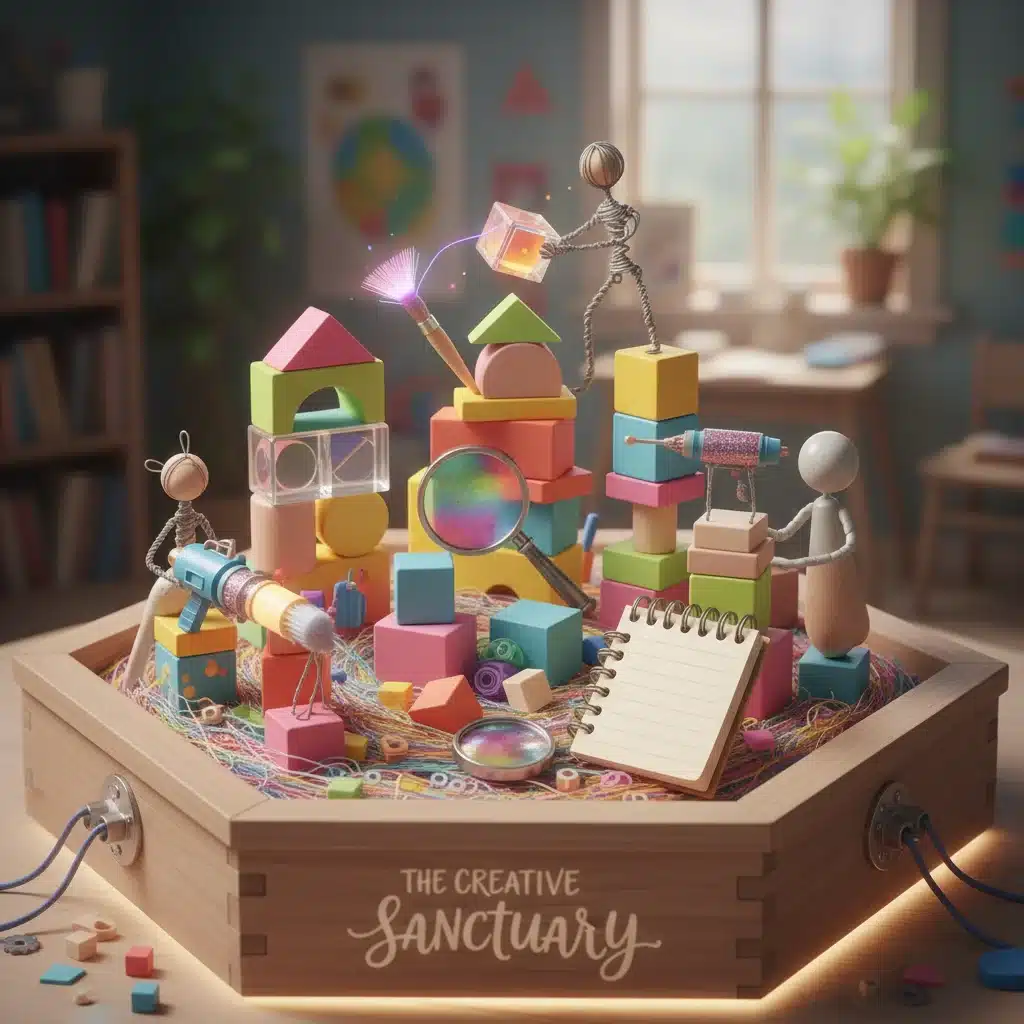
2. Cultivate a ‘Creative Sandbox’ for Fearless Experimentation
Fear of failure is a silent assassin of creativity. Many brilliant ideas never see the light of day because individuals are too afraid of judgment, criticism, or simply getting it wrong. To truly boost creative output, you need a safe space – a ‘creative sandbox’ – where experimentation is encouraged, mistakes are seen as learning opportunities, and judgment is suspended. This isn’t about producing polished work; it’s about playing, exploring, and generating raw material without the pressure of perfection.
Think of children playing in a sandbox. They build, they destroy, they rebuild, all without a predefined outcome or fear of failure. Their primary motivation is curiosity and the joy of creation. Adults, however, often lose this innate playfulness. A creative sandbox can be a physical space – a corner of your office dedicated solely to sketching, doodling, or tinkering with new tools. It can also be a dedicated time slot in your schedule, say, 30 minutes each day, where you engage in activities purely for the sake of exploration. This could involve learning a new skill unrelated to your main work, experimenting with different artistic mediums, or simply free-associating ideas in a journal.
The purpose of the creative sandbox is to detach the act of creation from the need for immediate utility or success. It’s where you allow yourself to be messy, to fail spectacularly, and to follow tangents wherever they lead. This practice helps to dismantle the internal critic that often stifles creativity. By regularly engaging in low-stakes creative play, you train your brain to be more adventurous and less inhibited. Over time, the fear of failure diminishes, and you become more confident in taking creative risks in your more significant projects, leading to a substantial increase in your ability to boost creative output. This dedicated space and time allow for the incubation of ideas that might seem absurd at first glance but often evolve into groundbreaking concepts.
3. Leverage Micro-Breaks for Cognitive Restructuring
The idea of working relentlessly to boost creative output is a common misconception. In reality, our brains need periods of rest and detachment to process information, make new connections, and generate insights. However, traditional long breaks aren’t always feasible or effective. This is where the power of ‘micro-breaks’ comes into play – short, deliberate pauses designed to shift your cognitive state and allow for ‘diffuse mode’ thinking.
Diffuse mode thinking, as described by Dr. Barbara Oakley, is a relaxed, big-picture way of thinking that allows different areas of the brain to connect and process information unconsciously. It’s often when you’re not actively focusing on a problem that the solution suddenly appears – in the shower, on a walk, or just before falling asleep. Micro-breaks are short bursts (2-5 minutes) of activity that take your mind away from the task at hand. Instead of checking social media, which often keeps your brain in a ‘focused mode’ and can be mentally draining, opt for activities that promote diffuse thinking.
Examples of effective micro-breaks include: gazing out a window at nature, stretching, listening to a single piece of instrumental music, taking a short walk to get water, or even just closing your eyes and practicing mindful breathing. The key is to avoid anything that requires intense focus or introduces new information. These brief mental vacations allow your subconscious to work on problems in the background, leading to unexpected breakthroughs and a significant ability to boost creative output. Integrate several micro-breaks into your workday, especially when you feel stuck or overwhelmed. You’ll return to your task with renewed clarity and often, a fresh perspective that was previously elusive.
4. Practice ‘Idea Grafting’ from Unrelated Domains
True innovation often stems not from inventing something entirely new, but from combining existing concepts in novel ways. ‘Idea grafting’ is a strategy that involves deliberately seeking inspiration and solutions from domains completely unrelated to your own and applying them to your challenges. This cross-pollination of ideas can lead to incredibly original and effective results, helping you to significantly boost creative output.
Think about how nature has inspired countless inventions, from Velcro (inspired by burrs) to bullet trains (inspired by kingfisher beaks). The principles of biomimicry are a prime example of idea grafting. But this strategy extends beyond nature. If you’re a software developer, how can the principles of classical music composition inform your code structure? If you’re a marketer, what can you learn about storytelling from ancient mythology or stand-up comedy? The more disparate the two domains, the more surprising and innovative the resulting ideas tend to be.
To practice idea grafting, consciously expose yourself to a wide variety of information and experiences outside your usual sphere. Read books on subjects you know nothing about, visit museums covering different eras or cultures, watch documentaries on obscure topics, or engage in hobbies that challenge your usual way of thinking. When faced with a creative problem, actively ask yourself: ‘How would a chef solve this problem?’ or ‘What principles from architecture could I apply here?’ This deliberate search for analogous solutions forces your brain to make unusual connections, breaking free from conventional thought patterns and allowing you to boost creative output by generating truly unique hybrid ideas. The initial effort to bridge seemingly unconnected fields will yield a rich harvest of innovative solutions.

5. Implement the ‘Morning Pages’ Ritual for Unfiltered Flow
For many, the blank page or empty screen is an intimidating barrier to creative expression. The internal critic, self-doubt, and the pressure to produce something ‘good’ can stifle ideas before they even fully form. The ‘Morning Pages’ ritual, popularized by Julia Cameron in ‘The Artist’s Way,’ is a powerful, yet simple, technique to circumvent these blocks and significantly boost creative output.
The concept is straightforward: every morning, immediately after waking up, write three pages of longhand, stream-of-consciousness prose. The content doesn’t matter. It’s not meant to be good, coherent, or even reread. It’s simply about getting whatever is on your mind – worries, dreams, observations, to-do lists, random thoughts – out onto the page. The act of writing, without censorship or judgment, serves as a mental decluttering process. It’s a brain dump that clears out the noise, allowing for clearer, more creative thinking later in the day.
This ritual works on several levels. Firstly, it trains your hand and mind to write, overcoming the initial inertia that often prevents creative work. Secondly, it externalizes anxieties and distractions, freeing up mental bandwidth for more productive thought. Thirdly, and most importantly for those seeking to boost creative output, it taps into your subconscious mind. Often, hidden insights, nascent ideas, and creative solutions will emerge organically within the flow of morning pages. You might find yourself writing about a problem you’ve been grappling with, and suddenly, a fresh perspective or a potential solution will surface, unbidden.
Consistency is key with Morning Pages. Commit to doing it every day for at least a month, and you’ll likely notice a profound shift in your creative confidence and mental clarity. It’s a low-stakes, high-reward practice that primes your brain for creative work, making it easier to access your inner muse throughout the rest of your day. This daily purge helps to dissolve creative blocks and fosters a more fluid connection to your creative self.
6. Practice ‘Structured Procrastination’ for Background Processing
Procrastination is typically seen as the enemy of productivity and creativity. However, ‘structured procrastination,’ a concept coined by philosopher John Perry, suggests that it can actually be a powerful tool to boost creative output when used strategically. The idea is to have a hierarchy of tasks and to always be working on something, even if it’s not the most urgent or important task on your list.
The core principle is this: creative problems, especially complex ones, often benefit from a period of ‘incubation.’ When you’re actively avoiding a difficult creative task (the ‘A’ task), your subconscious mind can continue to work on it in the background, even while you’re engaged in other, less daunting tasks (the ‘B’ and ‘C’ tasks). By deliberately putting off the most challenging creative project, you’re not just being idle; you’re allowing your brain to process information in a diffuse mode, making connections and generating insights without conscious effort.
To effectively use structured procrastination, you need to have a list of important but less intimidating tasks that you can work on while ‘procrastinating’ on your main creative challenge. For example, if your big creative task is writing a novel, you might procrastinate by editing an old short story, brainstorming ideas for a different project, or organizing your research notes. The crucial element is that you are still doing productive, albeit secondary, creative work. This keeps your momentum going and prevents true idleness.
This method helps to alleviate the pressure of the daunting creative task, making it less intimidating to eventually tackle. When you finally return to the ‘A’ task, you often find that your subconscious has already done a significant amount of the heavy lifting, and solutions or ideas flow more easily. Structured procrastination isn’t about laziness; it’s about intelligently managing your creative energy and allowing for the powerful, often unseen, work of your subconscious to boost creative output significantly. It’s about recognizing that not all creative work happens at the conscious, focused level.
7. Implement a ‘Creative Input Diet’ for Fresh Perspectives
Just as our bodies need a balanced diet of nutrients, our minds need a diverse and stimulating diet of creative input to consistently boost creative output. However, in today’s information-saturated world, we often consume a homogenous diet of content, sticking to familiar genres, news sources, and social media feeds. This leads to ‘creative stagnation,’ where your ideas start to sound like everyone’s because you’re feeding your mind the same information.
A ‘creative input diet’ involves consciously diversifying the information and experiences you expose yourself to. This isn’t just about reading more; it’s about reading differently, listening differently, and experiencing differently. If you typically read fiction, try non-fiction in a completely unrelated field, like astrophysics or ancient history. If you only listen to one genre of music, explore world music, classical, or experimental sounds. Watch foreign films, attend lectures on obscure topics, visit art galleries, or even just take a different route home to notice new details.
The goal is to intentionally seek out novelty and challenge your existing perspectives. Each new piece of information, each novel experience, becomes a potential building block for new ideas. When you combine disparate inputs, your brain is forced to forge new connections, leading to fresh insights and original concepts. This deliberate diversification prevents your creative well from drying up and ensures a continuous flow of inspiration. To truly boost creative output, you must continuously feed your mind with varied and rich intellectual nourishment.
Furthermore, consider a periodic ‘digital detox’ as part of your creative input diet. Over-reliance on digital media can lead to passive consumption and reduce the time available for active thought and reflection. By limiting screen time, especially from social media and news feeds, you create space for your own thoughts to emerge and for your brain to process the diverse inputs you’ve consciously gathered. This balance between varied input and thoughtful processing is crucial for sustained creative vitality. A deliberate and varied creative input diet ensures that your internal creative library is constantly expanding and cross-referencing, leading to an explosion of novel ideas.
Conclusion: Your Three-Month Journey to Boost Creative Output
The journey to consistently boost creative output is not a sprint, but a sustained effort involving deliberate practice and a willingness to explore unconventional paths. By embracing constraints, cultivating a creative sandbox, leveraging micro-breaks, practicing idea grafting, implementing morning pages, strategically using structured procrastination, and maintaining a diverse creative input diet, you are equipping yourself with a powerful toolkit for innovation.
Over the next three months, commit to integrating at least a few of these lesser-known strategies into your daily routine. Don’t expect instant miracles; creativity, like any skill, requires consistent effort and patience. However, as you diligently apply these techniques, you will begin to notice subtle yet profound shifts in your thinking. Ideas will flow more freely, your perspectives will broaden, and your ability to solve complex problems with originality will significantly improve. You will find yourself not just generating more ideas, but generating better, more impactful ideas. The goal is not just to produce more, but to produce with greater depth, ingenuity, and personal satisfaction.
Remember, creativity is an intrinsic human capacity waiting to be fully unlocked. These strategies are not magic bullets, but rather catalysts designed to help you tap into your innate potential. By consciously nurturing your creative mind with these unique approaches, you are investing in a future where innovative solutions and original expressions are not just aspirations, but a consistent reality. Start today, and witness the remarkable transformation in your ability to boost creative output, propelling you towards new heights of personal and professional achievement. Your creative breakthrough is within reach.