Unlocking Creative Flow: 3 Proven Techniques for Innovators in 2026 to Generate 10x More Ideas
In the relentless pursuit of progress, innovation isn’t just an advantage; it’s a necessity. As we hurtle towards 2026 and beyond, the demands on innovators to consistently generate groundbreaking ideas are escalating. The ability to tap into a sustained state of creative flow – that elusive mental state where ideas effortlessly emerge and productivity soars – is no longer a luxury but a critical skill. This comprehensive guide will unveil three proven creative flow techniques designed to empower innovators to generate not just more ideas, but 10 times more ideas, transforming their approach to problem-solving and pioneering new frontiers.
The landscape of innovation is constantly shifting. What worked yesterday might be obsolete tomorrow. Therefore, cultivating a robust and adaptable creative process is paramount. We’re talking about moving beyond sporadic bursts of inspiration to establishing a predictable, reliable system for idea generation. These creative flow techniques are not theoretical constructs; they are actionable strategies rooted in cognitive science, psychology, and the best practices of leading innovators worldwide. By mastering them, you will equip yourself with the tools to navigate complexity, embrace uncertainty, and consistently deliver revolutionary solutions.
Understanding the Essence of Creative Flow
Before diving into the techniques, let’s establish a clear understanding of what creative flow truly entails. Coined by psychologist Mihaly Csikszentmihalyi, ‘flow’ describes a state of complete absorption in an activity, characterized by energized focus, full involvement, and enjoyment in the process. It’s where your most brilliant ideas are born, where complex problems unravel with surprising simplicity, and where innovation feels less like work and more like play.
The Brain in Flow: A Neurological Perspective
From a neurological standpoint, creative flow is associated with a temporary hypofrontality – a downregulation of activity in the prefrontal cortex, the brain region responsible for self-monitoring, inhibition, and critical self-evaluation. This temporary ‘quieting’ of the inner critic allows for greater spontaneity, divergent thinking, and the free association of ideas. Simultaneously, other brain regions involved in attention, memory, and reward become highly active, creating an optimal environment for creative breakthroughs. Understanding this neurological basis helps us appreciate why certain techniques are so effective in inducing this state.
Why Creative Flow is Crucial for 2026 Innovators
The challenges of 2026 demand an unprecedented level of creative output. Global connectivity, rapid technological advancements (AI, quantum computing, biotechnology), and complex societal issues require innovators to think expansively and connect disparate concepts. Relying solely on brute force or occasional inspiration will not suffice. Developing consistent creative flow techniques allows innovators to:
- Accelerate Idea Generation: Produce a higher quantity and quality of ideas in less time.
- Enhance Problem Solving: Approach complex problems from novel angles, leading to more effective solutions.
- Boost Productivity and Efficiency: Work with sustained focus and energy, reducing burnout.
- Foster Resilience: Develop a positive relationship with challenges, viewing them as opportunities for creative exploration.
- Drive Sustainable Innovation: Build a continuous pipeline of new concepts and improvements.
Now, let’s explore the three proven techniques that will help you unlock this powerful state and revolutionize your creative output.
Technique 1: The ‘Deep Work Sprint’ Protocol with Intentional Disconnection
In an age of constant notifications and digital distractions, achieving deep, uninterrupted focus is a superpower. The ‘Deep Work Sprint’ Protocol, inspired by Cal Newport’s concept of Deep Work, combines structured periods of intense, distraction-free creative effort with intentional disconnection to recharge and allow for subconscious processing. This is one of the most powerful creative flow techniques for sustained output.
Phase 1: Preparation and Environment Optimization
- Define Your Creative Challenge: Before starting, clearly articulate the specific problem you’re trying to solve or the ideas you need to generate. Vague goals lead to vague outcomes.
- Eliminate All Distractions: This is non-negotiable. Turn off phone notifications, close unnecessary tabs, inform colleagues/family of your unavailability, and find a quiet space. Consider using noise-canceling headphones.
- Prime Your Mind: Spend 5-10 minutes reviewing relevant information, brainstorming existing ideas, or simply meditating to clear your mind. This sets the stage for focused work.
- Set a Time Limit (90-120 minutes): Deep work is mentally taxing. Optimal sprints typically last between 90 to 120 minutes. Use a timer to maintain focus.
Phase 2: The Deep Work Sprint
During this phase, your sole focus is on the creative task. Engage fully, allowing your mind to wander only within the confines of the problem. If you encounter a block, don’t immediately switch tasks. Instead, try different approaches to the same problem: free association, mind mapping, sketching, or even verbalizing your thoughts. The goal is to sustain intense focus without interruption.
Phase 3: Intentional Disconnection and Recharge
Once your timer goes off, immediately step away from the creative task. This is where the ‘intentional disconnection’ comes in. Engage in activities that are fundamentally different and require minimal cognitive load. Examples include:
- A brisk walk in nature.
- Light exercise.
- Listening to music without lyrics.
- Mindful meditation or breathing exercises.
- Engaging in a non-work-related hobby.
The key here is to avoid digital distractions (social media, emails, news feeds) during this recharge period. This allows your subconscious mind to continue processing the creative challenge in the background, often leading to ‘aha!’ moments when you least expect them. This period should be at least 30-60 minutes, ideally longer if possible. After this, you can choose to embark on another Deep Work Sprint or transition to other tasks.
Why this technique works for creative flow techniques:
This protocol leverages the brain’s ability to focus intensely for short bursts, followed by periods of diffuse thinking. The intentional disconnection prevents cognitive overload and allows for incubation – a critical component of creativity where ideas are formed and connected outside of conscious awareness. Regular practice trains your brain to enter the flow state more readily and sustain it longer.
Technique 2: The ‘Mindful Ideation Matrix’ for Divergent and Convergent Thinking
Generating a high volume of ideas is only half the battle; ensuring their quality and relevance is the other. The ‘Mindful Ideation Matrix’ is a structured yet flexible approach that combines mindful awareness with a systematic framework for both divergent (generating many ideas) and convergent (selecting and refining ideas) thinking. This is a powerful addition to your creative flow techniques arsenal.

Phase 1: Mindful Brainstorming (Divergent)
This phase is about quantity over quality, but with a mindful twist. Instead of frantic idea generation, we cultivate an open, non-judgmental awareness.
- Centering Practice (5-10 minutes): Begin with a short mindfulness exercise. Focus on your breath, observe your thoughts without judgment, and bring your awareness to the present moment. This calms the mind and reduces self-censorship.
- Prompt-Based Free Association: Introduce a specific creative prompt related to your challenge (e.g., ‘How might we make X 10x faster?’, ‘What if Y didn’t exist?’). For 20-30 minutes, write down every single idea that comes to mind, no matter how wild or impractical. The mindful state helps you bypass your inner critic. Don’t stop writing.
- Perspective Shifting: After the initial burst, introduce a new perspective. Imagine you are a child, an alien, a competitor, or a future consumer. How would they approach the problem? This helps break habitual thought patterns and generate truly novel ideas.
- Sensory Input Integration: If stuck, integrate a new sensory input. Listen to unfamiliar music, look at abstract art, or even smell a new scent. Our senses can trigger unexpected cognitive connections.
Phase 2: The Ideation Matrix (Convergent)
Once you have a large pool of ideas, it’s time to bring structure and focus. The Ideation Matrix helps you evaluate and refine them systematically.
- Categorization and Clustering: Group similar ideas together. Look for emerging themes, patterns, and connections. Give each cluster a descriptive name.
- Impact vs. Feasibility Matrix: Create a 2×2 matrix with ‘High Impact’ and ‘Low Impact’ on one axis, and ‘High Feasibility’ and ‘Low Feasibility’ on the other. Plot your idea clusters onto this matrix.
- Prioritization with ‘Future Lens’: Focus on the ‘High Impact, High Feasibility’ quadrant first. Then, consider ideas from the ‘High Impact, Low Feasibility’ quadrant – these are often breakthrough ideas that might become feasible with future technologies or a shift in approach. When evaluating, ask: ‘How would this idea resonate in 2026? What future trends does it align with or challenge?’
- Refinement and Combination: Select the top 3-5 ideas or clusters. Dedicate time to refine them. Can two ideas be combined to create something even stronger? What are the immediate next steps to explore these ideas further?
Why this technique works for creative flow techniques:
The Mindful Ideation Matrix ensures you generate a wide range of possibilities (divergent thinking) and then systematically filter and enhance them (convergent thinking). The mindful element reduces judgment during brainstorming, allowing for true creative freedom, while the matrix provides a robust framework for strategic evaluation, making this one of the most effective creative flow techniques for actionable innovation.
Technique 3: ‘Cross-Pollination Sprints’ with AI Co-Creation and ‘Pre-Mortem’ Analysis
Innovation rarely happens in a vacuum. The most potent ideas often emerge from the collision of diverse perspectives and disciplines. ‘Cross-Pollination Sprints’ leverage interdisciplinary collaboration, enhanced by AI co-creation, and fortified by a ‘pre-mortem’ analysis to stress-test ideas before significant investment. This is a forward-thinking approach to creative flow techniques.
Phase 1: Diverse Team Assembly and AI Integration
- Assemble a Cross-Functional Team: Bring together individuals with vastly different backgrounds, expertise, and cognitive styles. Include designers, engineers, marketers, ethicists, futurists, and even someone from an unrelated field. Diversity is the engine of innovation.
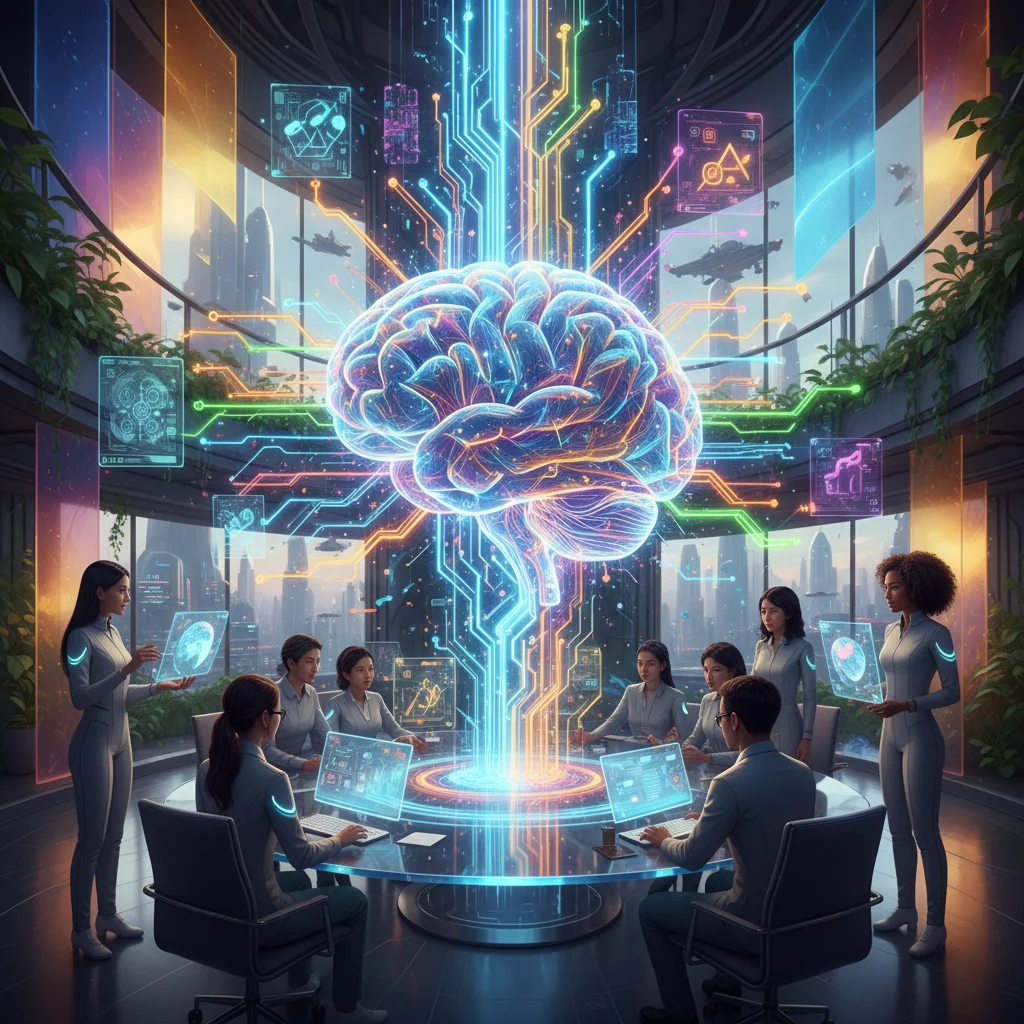
- AI as a Co-Creator: Integrate AI tools into your collaborative process. Use generative AI for initial idea prompts, pattern recognition across vast datasets, or to simulate potential outcomes. AI isn’t replacing human creativity; it’s augmenting it, serving as a powerful thought partner that can explore possibilities a human might miss.
- Shared Knowledge Base: Ensure all team members have access to a common, curated knowledge base related to the challenge, including market research, technological advancements, and ethical considerations.
Phase 2: The ‘Cross-Pollination’ Session
This session is designed to facilitate the rapid exchange and blending of ideas.
- Individual Brain Dumps (15 minutes): Each team member (and AI, if applicable) independently generates their initial ideas based on the challenge. Use a digital whiteboard or collaborative document.
- Round Robin Sharing & Building (30 minutes): Go around the room/virtual space. Each person shares one idea, and the next person builds upon it, combines it with another idea, or offers a new perspective. The rule is ‘Yes, and…’ – no immediate criticism. AI can also contribute by suggesting connections or extrapolations.
- Design Thinking Mini-Challenges: Introduce short, focused design thinking exercises. For example, ‘Empathize with User X for 5 minutes and generate a solution,’ or ‘Rapid prototype (sketch, verbalize) a solution to Y.’
- ‘Analogy Storming’: Ask the team to identify analogous problems or solutions from completely different industries or natural phenomena. How does nature solve this problem? How does a different industry approach a similar challenge?

Phase 3: ‘Pre-Mortem’ Analysis and Iteration
Once a set of promising ideas emerges, subject them to rigorous scrutiny before moving forward. This is a crucial step for refining your creative flow techniques into tangible outcomes.
- The ‘Pre-Mortem’ Scenario: Imagine it’s 2027, and your chosen idea has spectacularly failed. What went wrong? Why did it fail? Encourage the team to identify every conceivable pitfall: technological limitations, market resistance, ethical concerns, unforeseen competition, resource constraints, etc.
- Root Cause Analysis: For each identified failure point, delve into its root causes. Is it a flaw in the idea itself, a weakness in execution, or an external factor?
- Mitigation and Reinforcement: Based on the pre-mortem, brainstorm solutions to mitigate each potential failure. How can the idea be strengthened? What safeguards can be put in place? This process often leads to significant improvements and a more robust, resilient idea.
- Iterate and Refine: Use the insights from the pre-mortem to refine the idea. This might involve pivoting, adding new features, or simplifying the concept entirely. The goal is to emerge with an idea that has been stress-tested and improved.
Why this technique works for creative flow techniques:
Cross-Pollination Sprints foster collective intelligence and break down silos, leading to more holistic and innovative solutions. The integration of AI accelerates idea generation and analysis, while the ‘pre-mortem’ acts as a powerful de-risking mechanism, ensuring that the ideas that progress are not only novel but also viable and robust. This collaborative approach significantly enhances the collective creative flow of a team.
Integrating These Creative Flow Techniques into Your Daily Practice
Mastering these creative flow techniques requires consistent practice and integration into your routine. Here’s how to make them a part of your innovative lifestyle:
Start Small, Build Momentum
Don’t try to implement all three techniques perfectly from day one. Begin with one Deep Work Sprint per week, then gradually increase. Experiment with Mindful Ideation for smaller problems before tackling grand challenges. Introduce Cross-Pollination Sprints with a small, trusted group before expanding. The key is to build habits and see tangible results, which will fuel further adoption.
Schedule Creative Time
Treat your creative time as sacred. Block out dedicated slots in your calendar for Deep Work Sprints, Mindful Ideation, or collaborative sessions. Protect this time fiercely from meetings and other interruptions. When you prioritize creativity, your brain learns to anticipate and enter the flow state more readily.
Reflect and Adapt
After each creative session, take a few minutes to reflect. What worked well? What hindered your flow? Did the techniques help you generate more ideas? How was the quality of those ideas? Use these insights to adapt and refine your approach. Creativity is a dynamic process, and your methods should evolve with you.
Embrace Experimentation and Failure
Not every idea will be a winner, and not every session will be a profound breakthrough. That’s perfectly normal. Embrace experimentation as a core tenet of innovation. View ‘failures’ not as setbacks but as valuable learning opportunities that inform your next creative endeavor. The more you experiment with these creative flow techniques, the more proficient you’ll become.
Cultivate a Creative Mindset
Beyond the techniques, foster a mindset that nurtures creativity. This includes:
- Curiosity: Constantly question assumptions and explore new domains.
- Openness: Be receptive to new ideas, even those that challenge your existing beliefs.
- Resilience: Persevere through creative blocks and setbacks.
- Playfulness: Approach creative challenges with a sense of wonder and enjoyment.
- Continuous Learning: Stay updated on industry trends, new technologies, and diverse fields of knowledge.
The Future of Innovation: Beyond 2026
As we look beyond 2026, the integration of these creative flow techniques will become even more critical. The accelerating pace of change, the emergence of increasingly sophisticated AI, and the growing complexity of global challenges demand a new breed of innovator – one who is not only adept at technical skills but also masterful in harnessing their innate creative potential. By consciously cultivating creative flow, innovators will be better positioned to leverage advanced technologies, collaborate across vast networks, and envision solutions that are truly transformative.
AI as a Creative Partner
The role of AI in fostering creative flow will continue to expand. Expect AI tools to become even more intuitive in suggesting novel connections, generating diverse prompts, and even assisting in the early stages of idea validation. Innovators who learn to effectively co-create with AI will gain a significant competitive edge, turning what some fear as a threat into an unparalleled opportunity for amplified creative output.
The Importance of Human Connection
While technology advances, the human element of creative flow – empathy, intuition, and the unique ability to make abstract connections – remains irreplaceable. The Cross-Pollination Sprints highlight the enduring power of diverse human collaboration. Future innovators will need to be skilled facilitators of these human-AI hybrid creative ecosystems, ensuring that technology serves to enhance, not diminish, the richness of human interaction.
Ethical Considerations in Creative Flow
As our ability to generate ideas at scale increases, so does the responsibility to consider the ethical implications of our innovations. Integrating ethical ‘pre-mortem’ analyses and fostering diverse perspectives within creative teams will be essential to ensure that the ideas generated contribute positively to society and address potential harms before they materialize. Creative flow, when guided by a strong ethical compass, can be a force for immense good.
Conclusion: Unleash Your 10x Creative Potential
The journey to generating 10x more ideas is not a mythical quest; it’s a structured path paved with intention, practice, and the right creative flow techniques. By adopting the ‘Deep Work Sprint’ Protocol for focused execution, the ‘Mindful Ideation Matrix’ for balanced idea generation and refinement, and ‘Cross-Pollination Sprints’ with AI co-creation and ‘Pre-Mortem’ analysis for collaborative, resilient innovation, you are not just improving your creative output – you are fundamentally transforming your innovative capacity.
The innovators who thrive in 2026 and beyond will be those who consistently cultivate their creative flow, viewing it as a renewable resource that can be consciously tapped and amplified. Embrace these strategies, make them your own, and prepare to unlock a future where your ideas know no bounds. The world awaits your next big breakthrough.